For years, I thought our quilting department was running efficiently. We had two multi-needle quilting machines running side by side, each operated by two workers, plus two more workers handling the quilted fabric at the output end—folding, stacking, and moving rolls to the cutting station. Six people per shift, producing about 160 panels per shift. It seemed reasonable.
Then I visited a competitor's factory and saw something that changed my mind: a single IF-Q-1200 Computerized Multi-Needle Quilting Machine paired with an IF-QFS Automatic Quilted Fabric Stacking Machine, operated by just two people, producing 280 panels per shift. That was my wake-up call.
Before the upgrade, our quilting process worked like this: two operators loaded fabric rolls onto the quilting machines, monitored the stitching, and handled thread breaks. At the output end, the quilted fabric came out in a continuous roll. Two more workers caught the fabric as it exited, manually guided it to prevent wrinkles, cut it at the right length, folded it, stacked it on pallets, and moved the pallets to storage.
The manual stacking was the bottleneck. The quilting machines could run at 70% of their theoretical speed, but the stacking crew could not keep up. Every time the stacking fell behind, the quilting machine had to be slowed down or stopped. We were losing approximately 30% of our potential output because of this mismatch.
Manual stacking also had quality issues. The fabric would sometimes develop wrinkles at the folding point, causing defects in the cut panels. The stacking was inconsistent in length—different workers folded at slightly different lengths. And at the end of each shift, the stacking crew was exhausted from handling hundreds of meters of fabric.
The labor cost was significant: six workers per shift, two shifts per day, at approximately $2,800 per worker per month, totaling $33,600 per month just for the quilting department. And we still could not meet demand during peak seasons.
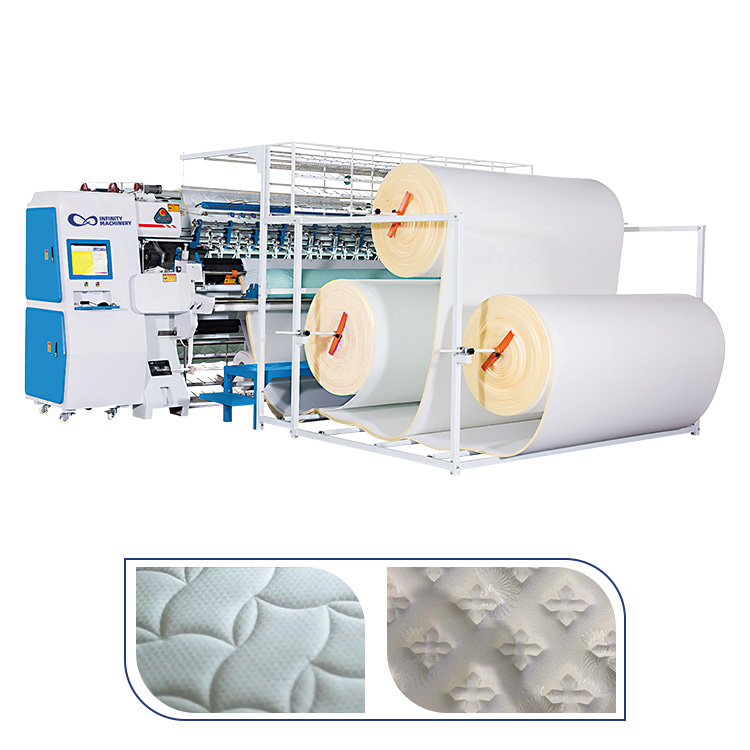
The IF-Q-1200 Computerized Chain Stitch Multi-Needle Quilting Machine was the centerpiece of the upgrade. It is a 1200mm-wide multi-needle quilting machine designed for high-volume mattress fabric production. The machine replaced two older, less efficient quilting machines while delivering higher output than both combined.
What impressed me most was the pattern flexibility. Our old machines could only do one pattern until physically reconfigured. The IF-Q-1200 stores up to 50 patterns in memory. When a customer orders a new mattress model with a different quilting pattern, we load the file and run it. No mechanical changes needed.
The stitch quality is noticeably better than our old machines. The chain stitch formation is consistent across the full fabric width, with no tension variation from one needle to another. The fabric feeds through smoothly, and the automatic fabric guiding system keeps the material aligned without constant operator attention.
We run the IF-Q-1200 at approximately 85% of its rated speed for most production, which gives us about 320 meters of quilted fabric per hour. At peak demand, we can push it to 95% for short periods. This is a significant improvement over our old machines, which struggled to maintain 200 meters per hour.
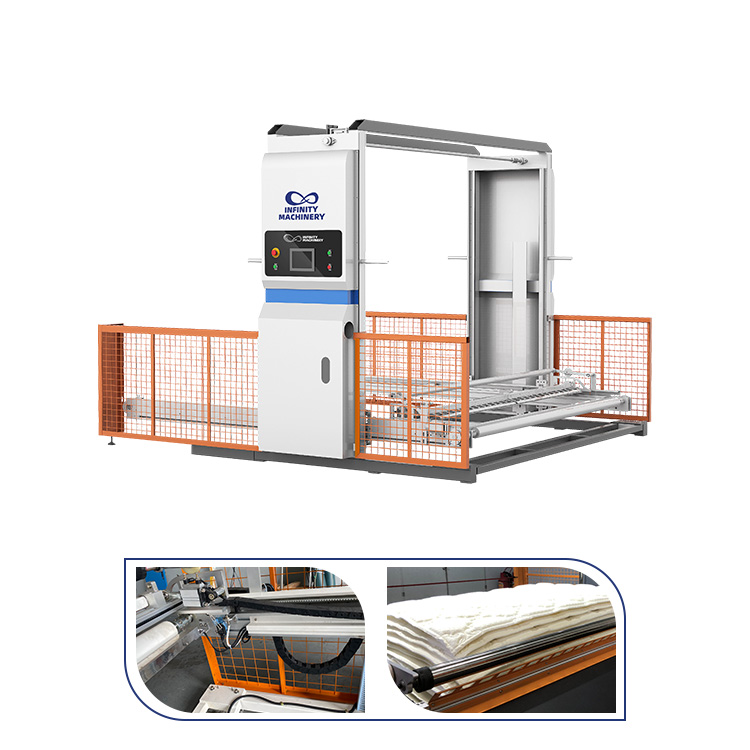
The IF-QFS Automatic Quilted Fabric Stacking Machine was the second half of the equation. It sits at the output end of the IF-Q-1200 and automatically receives, cuts, and stacks the quilted fabric. It eliminated the two-person stacking crew entirely.
The IF-QFS was surprisingly easy to integrate. Infinity Mattress Machinery provided the connection kit and sent a technician for half a day to calibrate the synchronization. After that, the system ran automatically. The operator simply loads fabric rolls onto the IF-Q-1200 input, sets the pattern and length, and the machine handles everything until the pallet is full.
The quality improvement was immediate. The automated stacking eliminated the wrinkles and length inconsistencies that plagued our manual process. Every panel now comes out exactly the same length, with clean trimmed edges. The defect rate from the quilting department dropped from approximately 5% to under 0.5%.
The financial impact was clear. Monthly labor savings of $22,400 plus rework savings of approximately $1,260 gave us a total monthly benefit of over $23,600. At a combined equipment cost of approximately $118,000, the payback period was just over five months.
The IF-Q-1200 and IF-QFS arrived as a matched set. Infinity Mattress Machinery's installation team had both machines installed, calibrated, and running within two days. The IF-Q-1200 required a standard 3-phase power connection and occupied roughly the same floor space as one of our old machines. The IF-QFS sits inline at the output end and added approximately 2 meters to the total line length.
Training was straightforward. Our two remaining operators learned the CNC control system in about three hours. The pattern creation software took a bit longer—about two days for the lead operator to become proficient at designing and loading custom patterns. The IF-QFS required virtually no training: it operates automatically once the system is set up.
We retrained the four displaced workers for other positions in the factory. Two moved to the cutting department, one to quality control, and one to shipping. No one was laid off, which was important for team morale.
After nine months of two-shift operation, the IF-Q-1200 has required needle changes every two weeks (standard wear, approximately $15 per set) and one thread tension adjustment after switching to a different thread brand. The automatic thread break detection has saved us from approximately 3-4 major fabric waste incidents that would have gone unnoticed on our old machines.
The IF-QFS has required blade sharpening once at month four ($45) and replacement of the stacking belt guides at month seven ($22). Daily maintenance is minimal: 10 minutes of cleaning at the end of each shift to remove lint and dust from the cutting and stacking mechanism.
Total maintenance cost in nine months: approximately $195 for both machines. Zero unplanned downtime. Zero emergency service calls. Compare this to our old machines, which required an average of one service call per month at approximately $250 per visit plus parts.
The servo motor on the IF-Q-1200 has been flawless. After thousands of hours of operation, the speed control is still as precise as day one. We have noticed a measurable reduction in our electricity bill—approximately $180 per month less than what we were paying to run the two old machines.
The most visible improvement was in the consistency of the quilted panels. Before, there was noticeable variation in panel length and fold quality between different operators and different shifts. With the IF-QFS handling the cutting and stacking automatically, every panel is identical.
Our largest customer—a regional mattress brand that buys approximately 35% of our quilted fabric production—commented on the improvement within the first month. Their cutting department reported that our panels now require 40% less adjustment time on their cutting tables because the edges are straight and the panel lengths are consistent.
The pattern precision of the IF-Q-1200 also opened new opportunities. We can now offer customers custom quilting patterns that were impossible with our old machines. One customer ordered a mattress line with a diamond quilting pattern that required precise needle synchronization across the full fabric width. The IF-Q-1200 handled it perfectly, and that customer has since tripled their order.
The automatic thread break detection also deserves credit. On our old machines, a broken thread could go unnoticed for several meters of fabric, creating a defect that required cutting out and discarding that section. The IF-Q-1200 stops within centimeters of a thread break, reducing fabric waste significantly.
If your quilting department is still using manual stacking, I strongly recommend automating it. The IF-QFS alone will pay for itself within a year just through labor savings, and the quality improvement is a bonus that keeps delivering.
If you are replacing old quilting machines, buy the IF-Q-1200. It outperforms two older machines while using less power, less floor space, and fewer operators. The pattern flexibility also gives you a competitive advantage that is hard to quantify but very real.
For factories that need both chain stitch and lock stitch capabilities, consider also the IF-QM1-4 Lock Stitch Quilting Machine as a complement. Chain stitch is excellent for most mattress applications, but lock stitch provides a different aesthetic and is preferred for certain premium products.
Infinity Mattress Machinery has been manufacturing quilting equipment for over a decade. Their machines carry CE and ISO 9001 certification. Contact them for a consultation. They will analyze your current process and provide a customized ROI projection.
Nine months after installing the IF-Q-1200 and IF-QFS, our quilting department is unrecognizable. Production is up 75%, labor costs are down 66%, defect rates have dropped by 90%, and our customers have noticed the quality improvement. The machines paid for themselves in just over five months.
Infinity Mattress Machinery manufactures quilting machines that are built to last. Their multim-needle quilting machines and automatic stacking systems are the standard in modern mattress factories. Contact them for a consultation and see how quickly an automated quilting line can pay for itself in your factory.
Tell us about your current quilting setup. We'll show you exactly how much you can save.


