For the first five years of running my mattress factory, foam waste was just a cost of doing business. Every day, our foam cutting department generated hundreds of kilograms of scrap—offcuts from profile cutting, edge trimmings from the splitting machines, and reject pieces from the foaming plant. We bagged it, palletized it, and paid a waste disposal company $180 per ton to take it away.
Then I discovered foam recycling. The IF-FFS3 Super Power Crushing Foam Machine and the IF-FZS1 Re-Bonding Foam Machine turned our biggest waste stream into our most profitable side product. We now recycle approximately 8 tons of foam waste per month and sell the re-bonded foam blocks for a monthly profit of over $14,000.
Our factory produces approximately 40 cubic meters of foam waste every month. The breakdown is typical for a mattress factory: profile cutting scraps from the IF-CNCV and IF-FZQA machines, edge trimmings from the IF-LT1650 horizontal cutter, end cuts from the IF-FF3 foaming line, and reject blocks from quality control.
Before we installed the recycling system, we were paying approximately $1,440 per month just for waste disposal. But the real cost was higher. The waste took up valuable floor space, required two workers part-time just to manage the waste stream, and represented a significant environmental liability.
I had always known that re-bonded foam existed. It is widely used in the furniture industry for sofa bases, cushion cores, and mattress support layers. What I did not know was that the equipment to make it had become affordable and efficient enough for a mid-sized mattress factory to justify.
The turning point came when one of our furniture-industry customers asked if we could supply re-bonded foam blocks for their sofa production. They were importing from another country at a high cost and wanted a local supplier. That conversation started our journey into foam recycling.
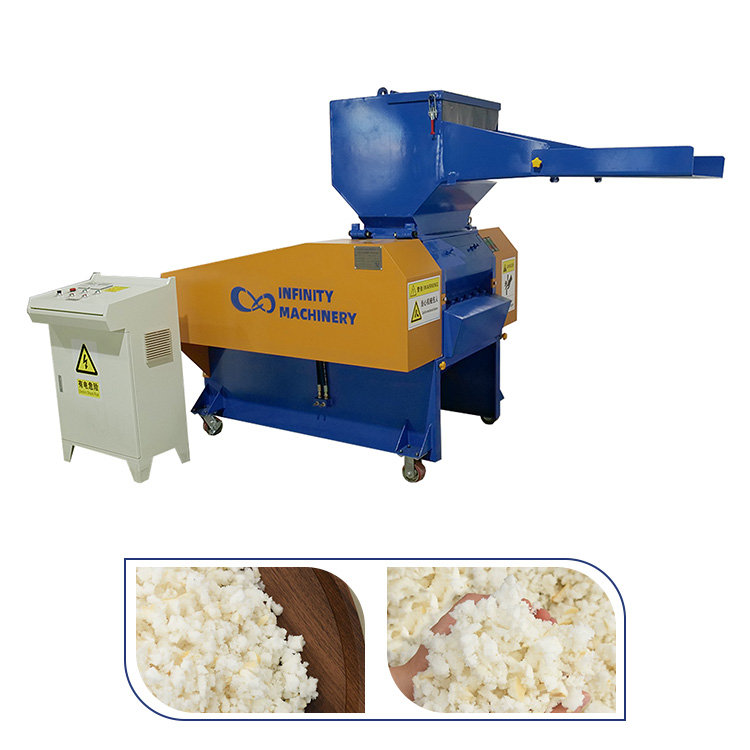
The IF-FFS3 Super Power Crushing Foam Machine is the first stage of the recycling process. It takes foam scrap of any shape or size and reduces it to uniform chips approximately 5-20mm in size. These chips become the raw material for the re-bonding process.
The IF-FFS3 replaced our old practice of manually cutting foam scraps into smaller pieces. What used to take two workers half a day now takes one worker less than an hour. The crushed chips are uniform in size, which is essential for consistent re-bonding quality.
We quickly discovered another benefit: the IF-FFS3 can also process foam offcuts from other local factories. We now accept foam waste from three nearby furniture factories at no charge, turning their waste into our raw material. This increased our monthly input from 8 tons to approximately 12 tons, with zero raw material cost.
One thing we learned early: the IF-FFS3 works best when foam scraps are pre-sorted by density. We have three collection bins labeled Soft (8-20 kg/m³), Medium (20-40 kg/m³), and Firm (40-80 kg/m³). This simple sorting step dramatically improves the consistency of the final re-bonded product.

The IF-FZS1 Re-Bonding Foam Machine is where the magic happens. It takes the crushed foam chips and bonds them together using steam and pressure to form solid, usable foam blocks. The process is surprisingly simple.
The process works like this: crushed foam chips are loaded into the mold, mixed with a small amount of adhesive if needed (approximately 5-8% by weight for low-density foams, less for higher densities). The lid is closed, steam is injected for 10-15 minutes, then the hydraulic press applies compression and holds it for 30-40 minutes while the bonds form.
After cooling and curing for 24 hours, the re-bonded blocks are ready for cutting. The blocks have a characteristic speckled appearance from the mixed foam chips. They are strong, resilient, and behave similarly to virgin foam of equivalent density.
The most common application for our re-bonded blocks is sofa cushion cores and mattress support layers. The furniture industry values re-bonded foam for its durability and consistent support characteristics. We sell our re-bonded blocks at approximately 60% of the price of virgin foam of equivalent density, giving our customers a significant cost saving while we maintain a healthy profit margin.
The numbers speak for themselves. Before recycling, foam waste cost us $17,280 per year in disposal fees. Now the same waste generates $177,600 per year in profit. The combined equipment cost of the IF-FFS3 and IF-FZS1 was approximately $68,000. The payback period was just over four months.
And these numbers are conservative. We have since started accepting foam waste from two other local factories, which increased our throughput without adding equipment costs. Our monthly profit from recycling has grown to approximately $18,500, and we expect it to reach $22,000 within six months as we expand our customer base.
Re-bonded foam blocks produced by the IF-FZS1 have consistent density and mechanical properties. We test every batch for density, compression set, and tensile strength. The results are remarkably consistent: density variation between batches is less than 5%, and the compression set performance is comparable to virgin foam of equivalent density.
Our primary market for re-bonded blocks is the furniture industry. Sofa manufacturers use them for seat cushions and backrests. Office chair manufacturers use them for seat pads. We also sell to mattress manufacturers who use re-bonded foam as a support layer in budget and mid-range mattress models.
The blocks can be cut using standard foam cutting equipment. We use our IF-FZQA Automatic Vertical Foam Cutting Machine to slice the blocks into sheets of precise thickness, and the IF-YX01 profile cutter for custom shapes. The re-bonded foam cuts cleanly with minimal dust or crumbling at the cut edges.
Customer feedback has been overwhelmingly positive. Our main furniture customer initially tested the re-bonded blocks for three months before committing to regular orders. Their quality control team found that the re-bonded foam performed equivalently to the virgin foam they had been using, at a 40% cost reduction. They have since switched 70% of their foam purchases to our recycled product.
The IF-FFS3 and IF-FZS1 arrived as a package from Infinity Mattress Machinery. Installation took three days, including electrical connections, steam line installation, and calibration. The machines require approximately 80 square meters of floor space, which we cleared by moving our waste storage area outdoors under a covered shelter.
Two workers run the entire recycling operation. One worker operates the IF-FFS3 for the first hour of the day to crush accumulated scrap. The same worker then loads and operates the IF-FZS1 for the remaining 7 hours, producing 6-8 blocks per day. The second worker handles block removal, storage, and loading for customer shipments.
Training took approximately one week for the lead operator. The IF-FFS3 is simple to operate: load scrap, select chip size, start the motor. The IF-FZS1 requires more skill—the operator needs to judge the correct adhesive ratio, steam time, and compression settings for different foam densities and desired final density.
After six months of operation, we have developed standard recipes for different final product specifications. For example, a 50 kg/m³ block for sofa cushions uses medium-density foam chips, 6% adhesive, 12 minutes of steam, and 40 minutes of compression at 35 tons. These recipes are documented and easy for any trained operator to follow.
The IF-FFS3 has required blade rotation once (at month three, took 30 minutes, zero cost) and regular daily cleaning of the crushing chamber (10 minutes at end of shift). The motor and drive system have required no maintenance beyond visual inspection.
The IF-FZS1 has required more attention. The steam seals were replaced once at month four ($85 for the seal kit). The hydraulic system needed a minor adjustment at month two (diagnosed remotely by Infinity's support team). Daily cleaning of the mold and steam injection ports is essential and takes approximately 15 minutes.
Total maintenance cost in six months: approximately $140. Zero unplanned downtime. The machines have been extremely reliable, and the remote support from Infinity Mattress Machinery has been responsive when we needed guidance.
Energy consumption is reasonable. The IF-FFS3 uses a 15kW motor that runs for approximately one hour per day. The IF-FZS1 uses approximately 25kW per batch (including steam generation) and runs for about 8 hours per day. Our total monthly electricity cost for the recycling operation is approximately $680.
Beyond the financial benefits, foam recycling has significantly reduced our environmental footprint. We are diverting approximately 8 tons of polyurethane foam from landfills every month. Over a year, that is nearly 100 tons of foam that would have taken centuries to decompose.
Our customers increasingly ask about sustainability. Being able to say that we operate a closed-loop foam recycling system has become a competitive advantage. Several customers have specifically mentioned our recycling program as a factor in choosing us over competitors.
We have also reduced our raw material costs. Every ton of re-bonded foam we sell is a ton of virgin foam we do not need to buy for our own production. This has reduced our overall foam procurement costs by approximately 12%.
If your factory generates more than 2 tons of foam waste per month, I strongly recommend looking into foam recycling. The economics are compelling at almost any scale, and the equipment has become reliable and affordable.
Start by measuring your foam waste for a month. Weigh it, categorize it by density, and calculate your disposal costs. Then contact Infinity Mattress Machinery for a consultation. They will help you size the equipment based on your waste volume and recommend the right configuration.
Consider also the IF-FZQA Automatic Vertical Foam Cutting Machine for cutting your re-bonded blocks into sheets. The combination of IF-FFS3, IF-FZS1, and IF-FZQA gives you a complete foam recycling and fabrication line.
In my opinion, foam recycling is the single highest-ROI investment a mattress factory can make. The payback is measured in months, not years. The ongoing profit is substantial. And the environmental benefit is something you can be proud of.
Six months into foam recycling, I can say with confidence that it was the best investment we have made. Not only does it eliminate our foam waste problem, but it has also created a profitable new revenue stream that continues to grow. Our customers appreciate the sustainability angle, our bottom line benefits from the additional profit, and our team takes pride in turning waste into a valuable product.
Infinity Mattress Machinery has been manufacturing foam recycling equipment for over a decade. Their machines carry CE and ISO 9001 certification. Contact them to discuss your foam waste situation. They will help you calculate your potential return on investment and recommend the right equipment for your factory.
Tell us about your foam waste volume. We'll calculate your potential savings and ROI.


