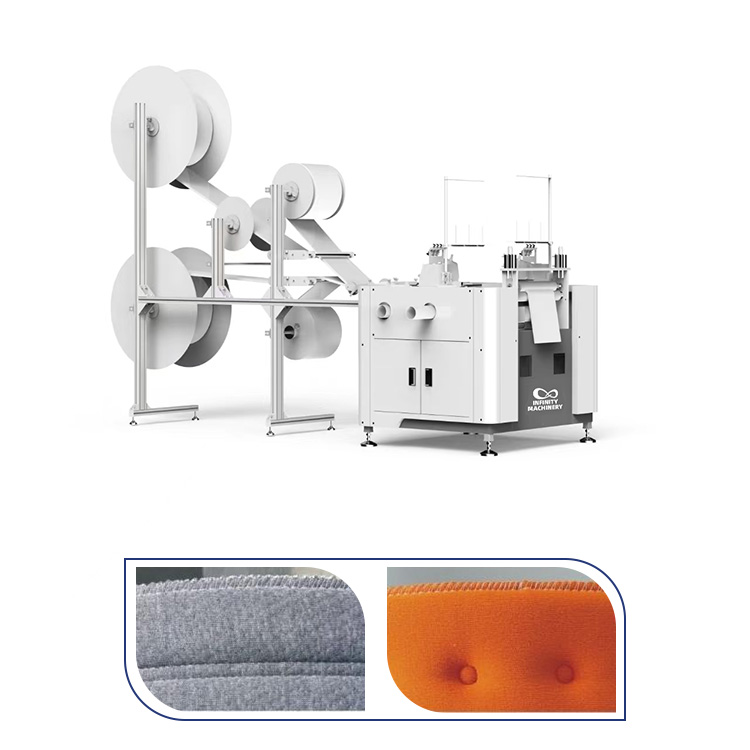
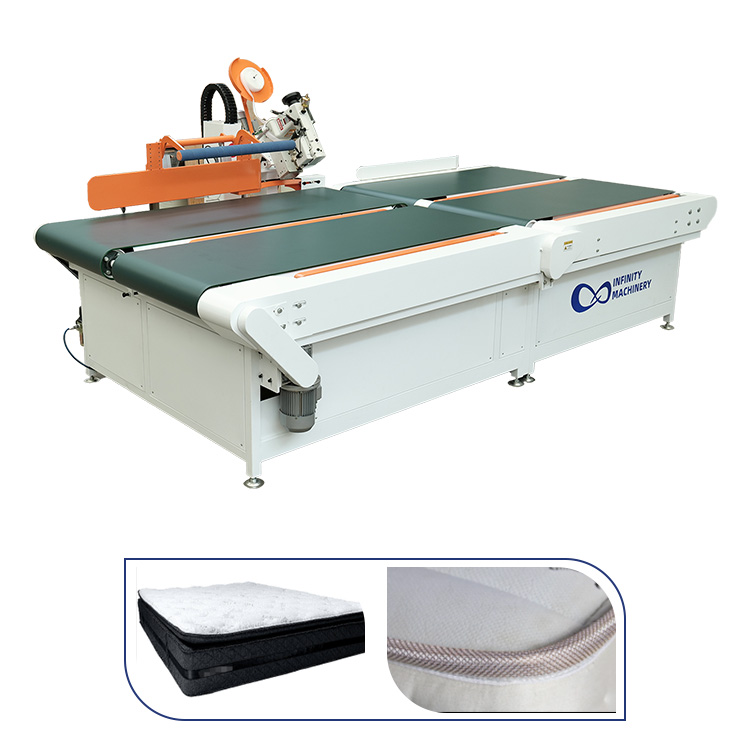
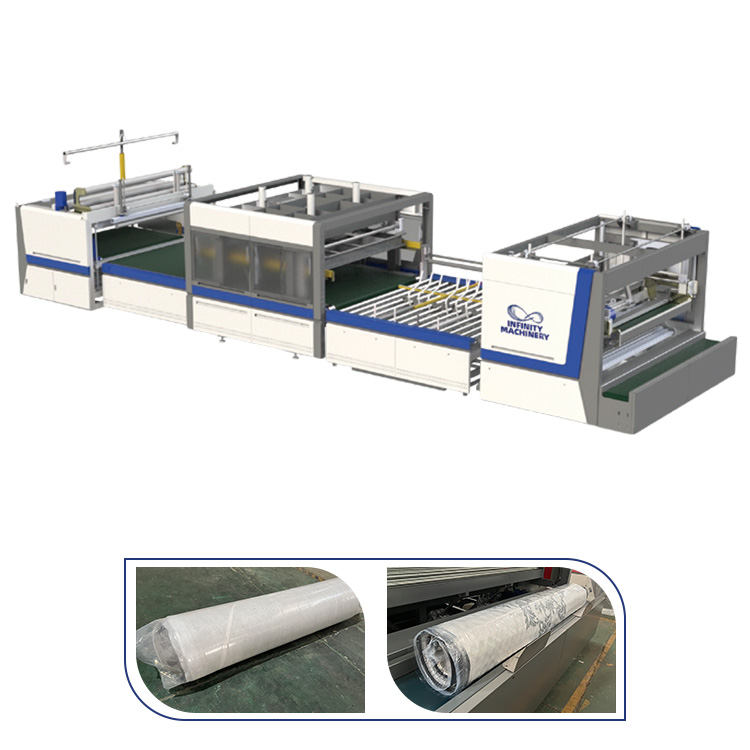
The sewing station is often the slowest part of the mattress finishing line. A single-head panel sewing machine sews the top panel and bottom panel in separate passes — requiring the operator to load, sew, unload, rotate the mattress, reload, and sew again. This double handling takes time and introduces variation between the two sides.
The IF-SB-A2 Front and Back Double-heads Mattress Sewing Machine solves this by sewing both panels simultaneously. Two independently controlled sewing heads work at the same time — one on the front panel, one on the back panel. The result is a 50% reduction in cycle time, consistent stitch quality on both sides, and a dramatic improvement in finishing line throughput.
This guide explains the double-head technology, compares it to single-head alternatives, and shows how the IF-SB-A2 fits into a complete finishing line.
The IF-SB-A2 has two sewing heads mounted on independent gantries. Each head has its own servo motor, thread tension control, and needle mechanism. The operator loads the mattress onto the worktable, aligns the top panel edge with one head and the bottom panel edge with the other, and starts the cycle. Both heads sew simultaneously — one sews the top panel to the border, the other sews the bottom panel to the border.
Key technology features:
| Factor | Single-Head | IF-SB-A2 Double-Head |
|---|---|---|
| Sewing passes per mattress | 2 (top then bottom) | 1 (both simultaneously) |
| Cycle time | 3-4 minutes | 1.5-2 minutes |
| Output per shift | 200-300 | 400-600 |
| Operators | 1 | 1 |
| Seam consistency | Good | Excellent (synchronous feed) |
| Training time | 3-5 days | 2-3 days |
The IF-SB-A2 handles a wide range of mattress fabrics with consistent quality:
Upgrading from a single-head to a double-head sewing machine delivers rapid payback through increased output and reduced labor:
The IF-SB-A2 is priced at approximately $14,000-18,000 depending on configuration.
Payback: ~$16,000 ÷ ($28,800 ÷ 12) = 6.7 months
Beyond direct labor savings, the reduced cycle time means your entire finishing line can produce 200-300 more mattresses per shift — a 50-100% capacity increase without adding floor space or overhead.
One concern manufacturers have about double-head machines is that they require more skill to operate. In practice, the IF-SB-A2 is actually easier to learn than a single-head machine. Because both panels are sewn simultaneously, the operator only needs to align the mattress once. On a single-head machine, the operator must align the mattress twice — once for the top panel and once for the bottom — doubling the opportunity for alignment errors.
Training typically takes 2-3 days. On day one, the operator learns basic operation: loading, alignment, and cycle start. By day two, most operators are producing acceptable seams. By day three, they reach 80% of full production speed. Full speed is achieved within one week.
The IF-SB-A2's touch-screen control panel stores settings for up to 50 different mattress models. Switching between models takes less than 30 seconds — the operator selects the model, and the machine adjusts stitch length, thread tension, and feeding speed automatically.
| Specification | Value |
|---|---|
| Sewing heads | 2 (independently controlled) |
| Cycle time | 1.5-2 minutes per mattress |
| Output | 400-600 mattresses per shift |
| Stitch type | Lock stitch |
| Stitch length range | 3-8mm (adjustable) |
| Motor type | Direct-drive servo (each head) |
| Fabric feed | Synchronous with adjustable expander |
| Model presets | Up to 50 mattress models |
The IF-SB-A2 sits at the center of the mattress finishing line, receiving quilted panels from the quilting/cutting department and sending finished mattress covers to the tape edge or flanging station. Its output of 400-600 mattresses per shift matches well with the IF-T4 tape edge machine (500-700/shift) and IF-CR2 packing machine (700-950/shift), making it the pacing machine in a balanced finishing line.
For factories producing more than 600 mattresses per shift, adding a second IF-SB-A2 doubles the sewing station capacity to 800-1,200 per shift — all with the same 1-operator-per-machine staffing model.
These three machines form a complete mattress finishing line — from panel sewing to tape edge to packing.
Our sewing specialists can help you evaluate the IF-SB-A2 for your finishing line and calculate the throughput increase.