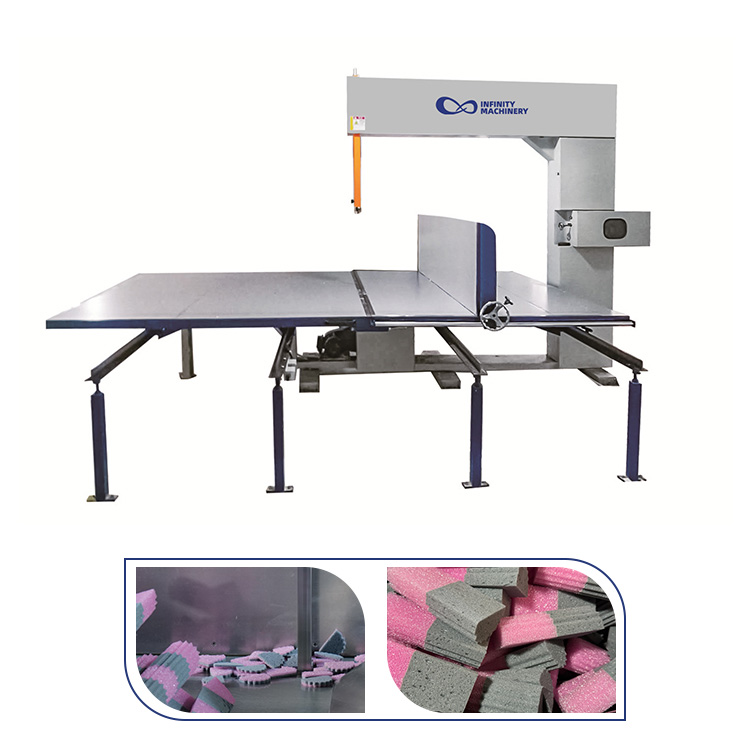
A well-equipped foam cutting department is the backbone of any mattress factory. Every mattress requires foam layers cut to precise dimensions — horizontal slices for the main support and comfort layers, and vertical cuts for edge trimming, block splitting, and dimensional sizing. Having the right combination of cutting machines determines whether this process is a smooth, efficient operation or a constant source of bottlenecks and waste.
The IF-FPQ1-1650/2150 Horizontal Foam Cutting Machine and the IF-FZQ3 Vertical Foam Cutting Machine cover the two fundamental cutting operations that every mattress factory needs: horizontal slicing and vertical cutting. Together, they form the core of a versatile foam cutting department that can handle any cutting task — from thin lamination sheets to thick support cores, from block trimming to precision dimension cutting.
Foam cutting in a mattress factory falls into two primary categories: horizontal slicing and vertical cutting. Each serves a distinct purpose and requires a different machine configuration.
Horizontal slicing is the process of cutting a foam block into flat sheets of uniform thickness. A typical mattress requires foam layers ranging from 5mm (thin lamination sheets for quilted panels) to 200mm (thick support cores). Horizontal slicing demands a long, straight blade and precise thickness control — the IF-FPQ1's specialty.
Vertical cutting involves cutting foam blocks to specific widths and lengths, trimming edges, and splitting blocks into smaller sections. Vertical cuts are used for dimensional sizing — cutting a large foam block into mattress-sized rectangles — and for shaping operations like edge profiling. The IF-FZQ3 handles these vertical cutting requirements efficiently.
The IF-FPQ1-1650/2150 Horizontal Foam Cutting Machine is a worktable-based horizontal cutter designed for slicing foam blocks into consistent sheets with digital precision. Available in 1,650mm and 2,150mm width models, it accommodates standard and extra-wide foam blocks.
The IF-FPQ1 features fully automatic digital control. The operator sets the desired cutting thickness on the control box, and the worktable automatically adjusts its height to maintain the correct blade position for each successive slice. The digital system stores up to 20 thickness presets, allowing rapid switching between mattress models without manual recalibration.
The machine automatically adjusts cutting parameters based on foam density — a critical feature that manual horizontal cutters lack. Denser foams require slower blade feed rates to maintain cut quality, while softer foams can be cut more aggressively. The IF-FPQ1's digital control compensates for these differences automatically, producing clean, consistent slices across the full range of foam densities used in mattress production.
With throughput of 10–14 blocks per shift (depending on block size and thickness), the IF-FPQ1 replaces 3–4 manual cutters while delivering superior consistency. Setup time between thickness changes is under 30 seconds, compared to 10–15 minutes for manual adjustment.
| Width (IF-FPQ1) | 1,650mm |
| Width (IF-FPQ2150) | 2,150mm |
| Control | Digital auto, 20 thickness presets |
| Throughput | 10–14 blocks/shift |
| Density Adjustment | Automatic |
While the IF-FPQ1 handles horizontal slicing, the IF-FZQ3 Vertical Foam Cutting Machine covers the vertical cutting operations that are equally essential for a complete foam cutting department. The IF-FZQ3 uses a vertical band blade to cut foam blocks to precise widths and lengths, trim uneven edges, and split blocks into smaller sections.
The IF-FZQ3 is designed for simple, reliable operation. The foam block is placed on the worktable and guided through the vertical blade along adjustable guides. The cutting width is set using the machine's positioning system, and the operator feeds the foam through the blade at a controlled rate. The vertical blade configuration produces clean, square cuts that are essential for mattress layers that need to fit precisely into mattress covers.
One of the IF-FZQ3's most valuable applications is edge trimming. Foam blocks from the foaming department often have slightly uneven edges where the foam expanded against the mold or conveyor walls. The IF-FZQ3 trims these edges cleanly, producing blocks with perfectly square corners that feed into the horizontal slicer without requiring manual pre-trimming.
The IF-FZQ3 is also used for splitting large blocks into smaller sections. A 2m × 2m foam block can be cut into four 1m × 1m sections for handling efficiency, or a 1.2m wide block can be trimmed to standard mattress widths (900mm, 1,200mm, 1,500mm, 1,800mm) with clean, accurate cuts.
| Blade Type | Vertical band blade |
| Applications | Edge trimming, block splitting, dimensional cutting |
| Operation | Simple, manual feed with adjustable guides |
| Certifications | ISO9001, CE, IEC |
When the IF-FPQ1 and IF-FZQ3 are deployed together, they create a complete cutting department that handles every foam cutting task efficiently. Here is the typical workflow:
Step 1 — Block preparation (IF-FZQ3): Raw foam blocks arrive from the foaming department. The IF-FZQ3 trims uneven edges and cuts blocks to standard widths. For a typical production run, this takes 5–10 minutes per block.
Step 2 — Horizontal slicing (IF-FPQ1): The trimmed blocks move to the IF-FPQ1 for horizontal slicing. The operator loads the thickness preset for the current mattress model — for example, 10mm for comfort layers, 20mm for transition layers, and 100mm for support cores. The IF-FPQ1 slices through the block automatically, producing consistent sheets.
Step 3 — Final sizing (IF-FZQ3): The sliced sheets from the IF-FPQ1 may require final dimensional cutting — trimming to exact mattress length and width. The IF-FZQ3 handles this quickly, cutting stacks of slices to the required dimensions in a single pass.
Step 4 — Assembly line: The finished foam layers — precisely cut, consistently thick, with clean square edges — move to the mattress assembly line. The entire cutting cycle for one mattress set (comfort layer + support core + any additional layers) takes approximately 15–20 minutes from raw block to finished component.
| Factory Size | Recommended Setup | Est. Investment |
|---|---|---|
| Small (up to 500/mo) | IF-FPQ1-1650 only | $6,000–$9,000 |
| Medium (500–1,500/mo) | IF-FPQ1-1650 + IF-FZQ3 | $9,000–$14,000 |
| Large (1,500–3,000/mo) | IF-FPQ2150 + IF-FZQ3 | $12,000–$18,000 |
| Enterprise (3,000+/mo) | 2× IF-FPQ + 2× IF-FZQ3 | $25,000+ |
The IF-FPQ1 + IF-FZQ3 combination is designed to scale with your factory. Starting with just the horizontal slicer and adding the vertical cutter as production grows is a cost-effective approach that avoids over-investing in capacity before it is needed.
The IF-FPQ1 Horizontal Foam Cutter and IF-FZQ3 Vertical Cutting Machine form the foundation of a complete, versatile foam cutting department. Whether your factory produces 200 or 3,000 mattresses per month, this combination covers every foam cutting requirement — from thin lamination sheets to thick support cores, from block trimming to precision dimensional cutting.
For new factories setting up a cutting department for the first time, the IF-FPQ1-1650 is the recommended starting point — it handles the most critical cutting operation (horizontal slicing) and pays for itself within 6–8 months by replacing manual cutting labor. As production grows and vertical cutting needs increase, adding the IF-FZQ3 completes the department at a modest additional investment.
For factories that already have a horizontal slicer, adding the IF-FZQ3 vertical cutter can immediately improve cutting efficiency by eliminating the bottleneck of manual vertical cutting and edge trimming. The combined system pays for itself within 12 months at most production volumes. Investing in the right combination of horizontal and vertical cutting equipment is the most direct path to a foam cutting department that operates efficiently, consistently, and profitably — regardless of your factory's size.
Contact us for a free consultation and equipment recommendation based on your factory's production volume and cutting requirements.