Facebook

From Foam Block to Finished Mattress: A Complete Production Walkthrough

Complete walkthrough of a modern mattress production line: from raw foam blocks, fabric rolls, and steel wire to finished packed mattresses. Covers 7 stages with timing, workforce, and automation details.
Jun 24th,2026 200 Views
PRODUCTION WALKTHROUGH

From Foam Block to Finished Mattress: A Complete Production Walkthrough

Follow every step of a modern mattress production line — from raw materials to the final packed product ready for shipping

Production Line Manufacturing Process Factory Automation

Have you ever wondered exactly how a mattress goes from raw foam blocks, fabric rolls, and steel wire to a finished product sitting in a customer's bedroom? The journey involves multiple specialized machines working in sequence — and when they are connected into an integrated production line like the IF-APL Mattress Automatic Production Line, the entire process becomes seamless and highly efficient.

In this walkthrough, we will take you through each production stage step by step. You will see what happens at every station, which machines are involved, how long each step takes, and how automated transfer systems move the mattress-in-progress from one stage to the next.

By the end, you will have a complete mental model of a modern mattress factory — and a clear picture of what it takes to build a production line that can output 400+ finished mattresses per shift.

7
Production Stages
From Start to Finish
400+
Mattresses Per Shift
With Integrated Line
60%
Less Labor Than
Manual Production

Stage 1: Raw Material Preparation — Where Every Mattress Begins

Every mattress starts as raw materials. Three main material streams feed into a production line:

  • Foam blocks — produced in-house using box foaming machines or purchased from external suppliers. The foam blocks arrive as large rectangular solids measuring approximately 2m × 2m × 1m and weighing 30-80 kg depending on density.
  • Fabric rolls — knitted, woven, or jacquard fabrics for the mattress cover, border fabric, and quilting layers. A typical factory stocks 15-20 different fabric SKUs to cover their product range.
  • Steel wire and spring components — for pocket spring or Bonnell spring mattress lines. Steel wire arrives in coils and is processed into springs on-site using automatic spring coiling and assembling machines.

In a fully integrated production line, these raw materials are staged at their respective starting stations and fed into the process automatically. The IF-APL line coordinates the flow so that each material arrives at the right station at the right time.

Stage 2: Foam Cutting and Shaping

Raw foam blocks are too large and imprecise for direct mattress production. The first processing step is cutting the foam into the exact sheets needed for each mattress layer:

  • Horizontal cutting — The foam block is sliced horizontally into sheets of precise thickness. For example, a base support layer might be 150mm thick, while a comfort layer might be 30mm. Horizontal foam cutting machines like those in the Infinity lineup achieve ±1mm accuracy on every slice.
  • Profile cutting — For contour shapes, egg-crate patterns, or ergonomic profiles, the foam sheets pass through a CNC contour cutting machine. These machines use a moving blade guided by digital patterns to cut complex shapes with high precision.
  • Peeling — For thin continuous sheets (2-30mm) used in mattress toppers and comfort layers, foam peeling machines produce uniform sheets up to 50 meters long from a single cylindrical foam block.

Cut foam sheets move to the next stage on conveyor belts or automated guided carts. The IF-APL line includes automated transfer systems that move cut foam directly to the quilting or assembly stations without manual handling.

Stage 3: Spring Assembly (For Spring Mattress Lines)

For pocket spring or Bonnell spring mattresses, the spring unit assembly happens in parallel with foam preparation:

  • Wire straightening and coiling — Steel wire is straightened, cut to length, and coiled into individual springs by automatic spring coiling machines. A single machine can produce 60-80 springs per minute.
  • Pocket spring assembly — Individual springs are inserted into fabric pockets and sealed. Automatic pocket spring assembly machines like the IF-PPA produce a continuous strip of pocketed springs, which is then cut to mattress length. Output: up to 800 pocket springs per shift.
  • Bonnell spring assembly — For Bonnell mattress lines, the coiled springs are assembled into a connected grid using automatic assembling machines. The completed spring unit is a rigid mesh that forms the mattress core.
  • Spring unit handling — Completed spring units are transferred to the assembly station, where they will be combined with foam layers.

In a full production line, the spring assembly runs simultaneously with foam cutting, quilting, and fabric preparation — all coordinated so that components arrive at the assembly station at the same time.

Stage 4: Quilting — Creating the Comfort Layers

While foam is being cut and springs are being assembled, the quilting department prepares the mattress cover layers. Quilting is the process of sewing together multiple layers of fabric and foam padding in decorative patterns:

  • Multi-needle quilting — Computer-controlled multi-needle quilting machines sew the top and bottom panels of the mattress cover. These machines can produce intricate patterns — from simple channel stitching to complex decorative designs — at speeds of 5-8 meters of quilted fabric per minute.
  • Panel cutting — Quilted fabric rolls move to a computerized panel cutter, which cuts them to exact mattress dimensions. The cutter automatically adjusts for pattern alignment, minimizing fabric waste.
  • Border quilting — The border fabric (the side panel of the mattress) is quilted separately on single-needle or specialized border quilting machines.

Completed quilted panels and borders move to the sewing station. In an integrated line, quilting and panel cutting are synchronized so that finished panels arrive at the sewing station just as the foam and spring components arrive at the assembly point.

Stage 5: Mattress Assembly — Bringing It All Together

This is the stage where the mattress takes its final shape. The foam layers, spring unit (if applicable), and quilted panels are assembled into a complete mattress:

  1. Layer stacking — The base foam layer is placed on the worktable, followed by the spring unit (if present), then the comfort foam layers. Automated layer placement systems ensure precise alignment of all layers.
  2. Border attachment — The border fabric is placed around the stacked layers. Sewing machines like the multi-head panel sewing machines attach the top and bottom panels to the border fabric in a single operation.
  3. Adhesive application (optional) — Some mattress designs require adhesive between layers to prevent shifting. Automated adhesive applicators spray a uniform layer of non-toxic adhesive between each layer as they are stacked.

The assembled mattress is now a complete unit — but it still needs finishing before it can be shipped.

Stage 6: Flanging and Tape Edge Finishing

The finishing stage gives the mattress its final, retail-ready appearance. Two finishing methods are used depending on the product design:

Flanging

The border fabric is sewn directly to the top and bottom panels without an additional tape strip. Result: a clean, seamless edge appearance preferred for modern mattress designs. A skilled operator can flange 400-600 mattresses per shift.

Tape Edge

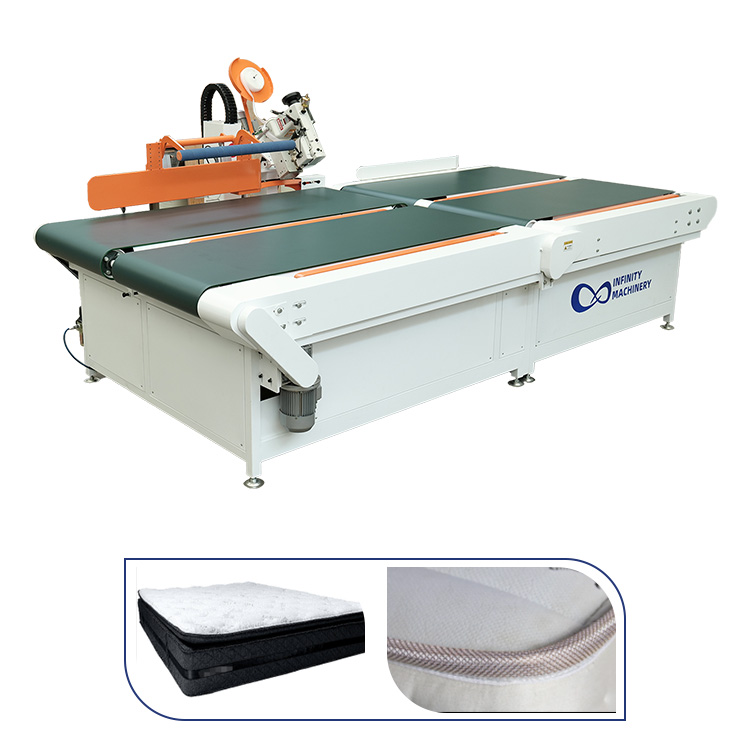
A decorative tape strip is applied around the mattress perimeter and sewn through all layers. This creates a classic, traditional mattress look. Automatic tape edge machines can process 500-700 mattresses per shift.

Many factories in the IF-APL line run both flanging and tape edge stations, giving them the flexibility to produce both modern and traditional mattress designs on the same production line.

Stage 7: Compression, Packing, and Shipping

The final stage transforms a bulky finished mattress into a compact, shippable package:

  • Compression — The mattress is compressed vertically to remove air from the foam layers. A hydraulic press reduces mattress thickness by 70-80% in seconds.
  • Rolling — The compressed mattress is rolled into a tight cylinder. Combined with compression, this reduces the mattress volume by approximately 78% — from 0.75 cubic meters to 0.16 cubic meters for a queen-size mattress.
  • Wrapping and sealing — The rolled mattress is wrapped in a protective plastic film and sealed. Automatic packing machines like the IF-CR2 or IF-AMB handle this entire process in 30-40 seconds per mattress.
  • Labeling and palletizing — Completed packages are labeled with product information, barcodes, and shipping labels, then palletized for loading.

Total Production Timeline: How Long Does It Take?

Here is how long each stage takes in a modern integrated production line like the IF-APL:

Stage Time Per Mattress Workers Automation Level
Foam cutting & shaping 45 sec (batched) 1-2 High
Spring assembly (if applicable) 60 sec (batched) 1-2 High
Quilting & panel cutting 90 sec (batched) 1-2 High
Assembly (stack + sew) 120 sec 2-3 Medium
Flanging / tape edge 45-90 sec 1-2 Medium-High
Compression & packing 30-40 sec 1-2 High

Total per mattress: Approximately 6-8 minutes of combined machine and labor time, with multiple stations working in parallel. Actual throughput is 400-600 finished mattresses per 8-hour shift, depending on mattress complexity and workforce size.

3 Essential Machines for Your Production Line

Whether you are building a new production line or upgrading an existing one, these three machines form the backbone of an efficient mattress factory.

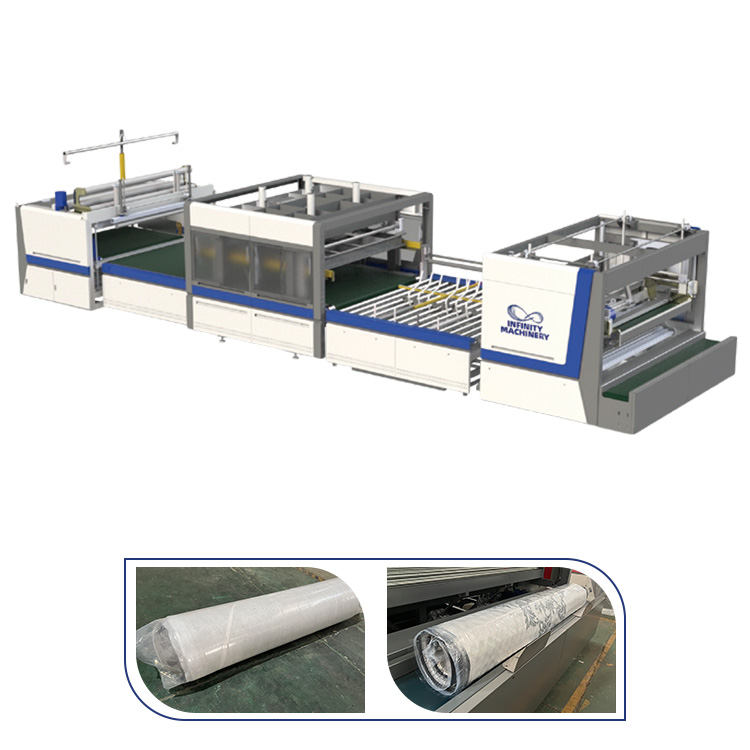
IF-APL Mattress Automatic Production Line
INTEGRATED LINE

IF-APL Production Line

The complete automatic production line connecting every stage from raw material to finished mattress. Customizable for foam, spring, and hybrid mattress types.

IF-CR2 Automatic Mattress Roll Packing Machine
PACKING

IF-CR2 Packing Machine

PLC-controlled automatic roll packing. Compresses, rolls, and wraps in 30-40 seconds. The perfect end-of-line solution for your production line.

IF-T4 Automatic Tape Edge Machine
RECOMMENDED UPGRADE

IF-T4 Tape Edge Machine

High-speed automatic tape edge finishing. Adds professional tape edge capability to your production line for traditional mattress designs.

Conclusion: Building Your Mattress Production Line

A modern mattress production line is a carefully orchestrated sequence of specialized machines, each performing its task with precision and speed. From the raw foam block entering the cutting station to the finished rolled mattress emerging from the packing machine, every step is designed to maximize throughput while maintaining consistent quality.

The key to a successful production line is not just having the right individual machines — it is having them integrated into a seamless flow. The IF-APL production line connects every stage with automated material handling, synchronized timing, and centralized control.

Whether you are starting from scratch or upgrading an existing factory, the seven stages outlined in this walkthrough provide the blueprint for an efficient, scalable mattress production operation.

Ready to Build Your Production Line?

Our production line specialists can help you design a complete IF-APL line tailored to your factory space, product types, and target output volume. Get a free consultation and layout proposal.

Contact Us

We warmly welcome you to partner with us and build long-term benefits through our future collaborations.
Name*
Email*
Message*
Mobile/ WhatsApp*
Country*
Company Name
Leave a message
Name*
Email*
Message*
Mobile/ WhatsApp*
Country*
Company Name
We use Cookie to improve your online experience. By continuing browsing this website, we assume you agree our use of Cookie.